China's New Five-Year Plan Raises Fears of Lasting Control Over Uyghurs
Experts warn that China’s next five-year economic plan could reinforce surveillance, labor control and cultural restrictions imposed on Uyghurs since 2017, making these policies a lasting part of the region’s governance.
 Published:
Key points
- China unveils new five-year plan
- Plan reinforces surveillance and labor control
- Experts warn of lasting Uyghur control
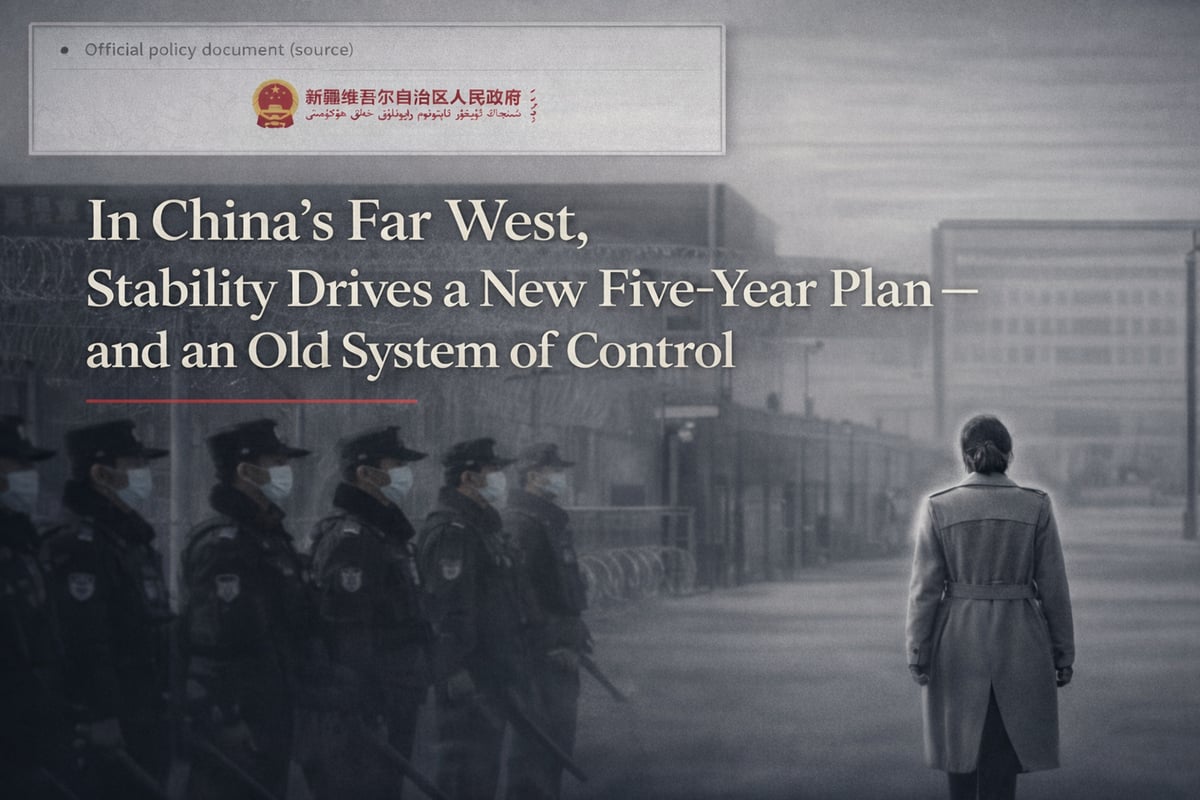
Researchers say Beijing's economic priorities in the Uyghur region could reinforce surveillance, coercive labor policies and cultural assimilation rather than ease restrictions introduced since 2017.
China's new five-year economic plan could deepen government control over Uyghurs by expanding industrial development and economic integration while maintaining the security and labor policies introduced since 2017, according to researchers who study the region.
The plan, covering 2026 to 2030, places the Uyghur region at the center of Beijing's ambitions for energy security, industrial growth and trade with Central Asia and Europe. But researchers warn that these priorities are closely tied to a system of surveillance, labor control and cultural assimilation that has transformed Uyghur society over the past decade.
The regional legislature approved the plan on January 31, 2026, ahead of the national legislature's approval of China's broader development blueprint on March 12.
In a December 22, 2025, announcement, the regional government said it was seeking public comments on draft planning documents. Erkin Tuniyaz, chairman of the region officially known as the Xinjiang Uyghur Autonomous Region, which many Uyghurs call East Turkistan, said the new plan would follow Communist Party directives while taking account of local conditions and the expectations of people across the region.
He described the coming planning period as a “critical stage” for consolidating foundations and advancing modernization.
The plan promises industrial growth, infrastructure investment and improved living standards. Researchers, however, question whether these economic goals will improve opportunities for Uyghurs or further strengthen the government's control over their lives.
Beijing's strategic priorities
China has identified the Uyghur region as a major component of its national economic and security strategy.
Under what Beijing calls the "Five Major Strategic Positionings," the region is designated as a gateway for trade with Europe and Asia, a base for energy and resource security, a supplier of agricultural and livestock products, and a strategic barrier protecting China's borders and national security interests.
These priorities give the region an important role in China's efforts to secure supply chains and expand trade routes westward. Regional officials have also repeatedly linked economic development to the maintenance of political stability.
“The region is being treated primarily as a strategic space,” said Ondřej Klimeš, a researcher at the Oriental Institute of the Czech Academy of Sciences who studies Chinese state policy and governance in the Uyghur region. “Economic, cultural, and social policies are increasingly subordinated to national and geopolitical objectives.”
The emphasis on stability comes after years of severe restrictions on Uyghur life.
Beginning in 2017, Chinese authorities carried out mass arbitrary detention, expanded surveillance and imposed sweeping restrictions on religious and cultural practices. Researchers also documented forced sterilization of Uyghur women and large-scale labor transfers, drawing on leaked government documents, satellite imagery and survivor testimony.
In January 2021, the United States determined that China was committing genocide and crimes against humanity against Uyghurs. The Biden administration maintained that determination.
In August 2022, the United Nations human rights office concluded that China's actions in the region may constitute international crimes, in particular crimes against humanity. Amnesty International and Human Rights Watch have also documented widespread abuses.
China rejects accusations of genocide and forced labor, maintaining that its policies have reduced extremism, improved security and created economic opportunities.
Researchers interviewed for this article say the security system built during those years has not disappeared, even as some of its most visible measures have changed.
Labor policies and economic integration
Labor policy is one of the main concerns raised by researchers examining the new plan.
Chinese authorities have long described "labor transfer" and employment programs in the Uyghur region as "poverty-alleviation" and "stability measures". Human rights researchers, however, have documented coercive practices, restrictions on workers' freedom of movement and programs that place Uyghurs in factories within the region and elsewhere in China.
Klimeš said the new plan indicates that Beijing intends to continue these policies.
“The plan signals the Communist Party’s intent on continuation and even strengthening of the previous policies of the Xi era, including forced labor,” Mr. Klimeš said. “The CCP vows to further integrate the Uyghur Region’s economy with China’s interior and with its global economic strategy.”
Klimeš pointed to employment programs within the region and transfers of Uyghur workers to factories in China's interior provinces, including through programs such as “partner assistance to Xinjiang.”
For Rune Steenberg, an anthropologist and principal investigator at Palacký University Olomouc who has conducted extensive fieldwork in the Uyghur region, the concern is not limited to the conditions under which Uyghurs work. He also questions whether they will have opportunities to own businesses or take leading roles in the expanding economy.
“The plan suggests a more mechanised and larger-scale economy,” Steenberg said. “This will probably mean less chances for Uyghurs to be involved in the economy in leading, managing or owning capacities.”
He said the economic changes must also be considered alongside the destruction of Uyghur social institutions and community networks since 2017.
“Along with the dismantlement of Uyghur culture and social structure and the ongoing fragmentation of Uyghur communities,” Steenberg said, “it means a precariarisation of large parts of the Uyghur population and little choice but to engage in factory labour and labour transfers under bad conditions.”
Steenberg also raised concerns about the consequences of automation, particularly for workers who have limited control over their employment or access to land.
“The rise in mechanisation, digitisation and AI, along with the land grab that has taken place since 2017, may even mean that unemployment becomes a bigger problem than labour transfers and coerced labour.”
His assessment raises another question about the government's development strategy: whether larger industries and greater use of technology will create meaningful opportunities for Uyghurs or leave them increasingly dependent on state-directed employment.
A lasting system of control
The Chinese government's approach to the Uyghur region has changed since the peak years of mass detention between 2017 and 2021. But researchers warn that some restrictions have become part of ordinary administration.
Surveillance, political vetting, neighborhood monitoring and workplace oversight continue to affect daily life, according to researchers examining the region.
Steenberg said the apparent easing of some earlier measures should not be mistaken for the end of state control.
“There is a normalisation happening,” Steenberg said, “but it is not exactly of the very violent situation in the years 2017–2021. It is coloured by those years, but an easing of some policies and the creation of a more sustainable regime of control has been created since that now seems to become solidified.”
Klimeš said Beijing's long-term objectives are unlikely to change because the Communist Party considers the region vital to China's security and international strategy.
“The fact that the CCP regards its New Frontier as crucial in state security and global strategy implies continuing normalization and standardization of its long-term governance approach,” he said. “The interests of Uyghurs and other nations of East Turkistan will likely continue to be of limited priority in the party’s thinking.”
For Uyghurs, the consequences extend beyond surveillance or restrictions on movement. Government policies have also altered schools, religious institutions, public spaces and the use of the Uyghur language.
The future of Uyghur culture
Since 2017, Chinese authorities have imposed extensive restrictions on Uyghur religious practices, language education and cultural expression. The removal of Uyghur place names and changes to historic neighborhoods have raised additional concerns about the future of Uyghur cultural identity.
In a 2024 investigation, Human Rights Watch documented the renaming of approximately 630 villages in the Uyghur region. Many of the original names carried references to Uyghur history, religion or cultural traditions.
Similar concerns have emerged in Kashgar, where historic Uyghur street names have been replaced.
Chinese authorities describe such changes as part of modernization and efforts to strengthen a shared national identity. Researchers say they are removing important connections between Uyghurs and their history.
Klimeš said the plan is unlikely to reverse this direction.
“The Xi-era forced assimilation of Uyghurs and other nations of East Turkistan is also likely to continue under the guise of building the consciousness and community of the so-called Chinese nation,”
Steenberg said the government's cultural policies have gone beyond restrictions on traditional practices. He described a process in which the authorities have weakened existing Uyghur cultural institutions while promoting an officially approved version of regional culture.
“Uyghur culture is being destroyed and substituted,” he said. “The Chinese government has, with its very repressive policies in 2017–2021 and its normalisation of the surveillance and fear they brought, managed to destroy substantial parts of Uyghur culture and society.”
He said Chinese authorities are investing heavily in promoting what he described as a state-curated “Xinjiang culture,” which presents selected elements of the region's traditions while excluding aspects of Uyghur identity that do not fit the government's political objectives.
“From the outside it can sometimes be difficult to distinguish between actual social structure and community on the one side and make-believe propaganda smoke screens on the other,” Steenberg said. “But to people on the ground and to those who know the region intimately from before 2017, the difference is painfully real.”
The concerns expressed by Klimeš and Steenberg reflect a broader question about the direction of Chinese policy in the region: whether the government will eventually loosen the restrictions imposed over the past decade or make them a permanent part of its administration.
Gordon G. Chang, a China analyst and senior fellow at the Gatestone Institute, said he sees little prospect of a significant reversal.
“China’s Han Nationalist regime does not know how to loosen controls on minorities,” said Chang. “There is no reverse gear when it comes to Uyghurs and other Turkic minorities.”
The five-year plan sets out Beijing's economic priorities through 2030, with promises of industrial expansion, improved infrastructure and higher living standards.
For Uyghurs, researchers say, the question is whether those developments will bring greater freedom and opportunities to shape their own future, or further strengthen the institutions that have restricted their lives since 2017.